Introduction:
For centuries, understanding complex systems has depended upon direct observation. Engineers have monitored machinery, physicians have examined patients, and city planners have relied upon historical data to guide future decisions. While models and simulations have long supported these activities, they have traditionally represented simplified snapshots rather than continuously evolving reflections of reality.¹
Advances in sensor technology, cloud computing and artificial intelligence are transforming this approach. Organisations are increasingly developing digital twins: dynamic virtual representations of physical objects, systems or environments that update continuously using real-world data.² Unlike conventional simulations, digital twins evolve alongside the assets they represent, providing an ongoing picture of current performance while enabling predictions about future behaviour.
Digital twins are now being applied across a wide range of sectors. Manufacturers use them to optimise production lines, hospitals explore patient-specific models to improve treatment planning, and cities employ them to understand traffic flows, energy consumption and infrastructure resilience.³ As the availability of connected sensors and computational power continues to grow, digital twins are becoming an increasingly important component of modern decision-making.
These developments extend beyond operational efficiency. By combining real-time data with artificial intelligence, digital twins allow organisations to anticipate problems before they occur, evaluate alternative scenarios and improve long-term planning. The question is no longer whether virtual models can support real-world decision-making, but how these evolving digital systems may reshape the way complex environments are understood and managed.
Understanding Digital Twins
Although digital twins are often associated with three-dimensional visualisations, they represent considerably more than sophisticated digital models. A digital twin is a living representation of a physical asset or system that receives continuous streams of data from sensors, operational databases and connected technologies.⁴
This continuous exchange distinguishes digital twins from traditional simulations. Conventional models are generally created for a specific purpose and remain static unless manually updated. Digital twins, by contrast, evolve alongside their physical counterparts, reflecting changing conditions in near real time.
Artificial intelligence plays a central role within this process. Machine learning algorithms analyse incoming information, identify patterns and generate predictions regarding future performance. Rather than simply describing what is happening, digital twins increasingly help organisations understand what is likely to happen next and which interventions may produce the most favourable outcomes.
As connected technologies become more widespread through the Internet of Things (IoT), digital twins are expanding from individual components to entire organisations, infrastructure networks and natural environments.
Applications Across Industry
Digital twins have already become established across numerous sectors where understanding complex systems is essential.
Within manufacturing, digital twins enable organisations to monitor production equipment continuously, predict maintenance requirements and optimise industrial processes before costly failures occur. Aircraft manufacturers similarly use digital twins to monitor engine performance throughout operational lifecycles, improving both efficiency and safety.⁵
Healthcare represents another rapidly developing area. Researchers are exploring patient-specific digital twins capable of integrating medical imaging, physiological data and genetic information to support personalised treatment planning. Although many applications remain experimental, digital twins may eventually enable clinicians to evaluate treatment options within virtual environments before applying them to individual patients.⁶
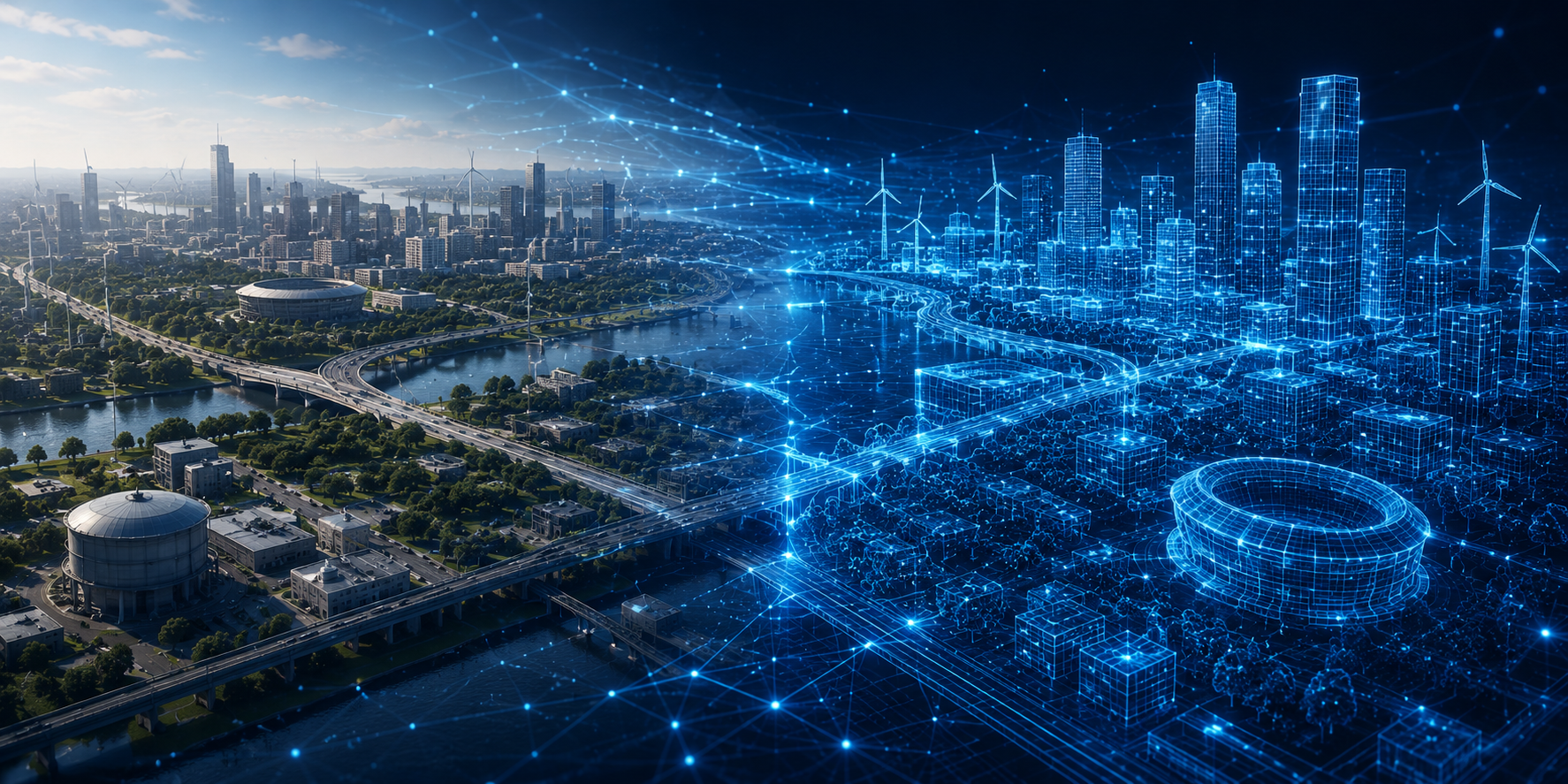
Cities are increasingly adopting digital twin technologies to improve urban planning and infrastructure management. Virtual city models integrate data relating to transport networks, utilities, environmental conditions and population movement, allowing planners to evaluate the potential consequences of policy decisions before implementing them within the physical environment.⁷
Environmental science also benefits from this approach. Digital twins of rivers, forests and climate systems enable researchers to simulate changing conditions, improve resource management and strengthen resilience against environmental risks.
Across each of these applications, the objective remains consistent: improving understanding by connecting real-world data with predictive digital models.
Artificial Intelligence and Predictive Decision-Making
Artificial intelligence significantly expands the capabilities of digital twins by transforming them from monitoring tools into predictive decision-support systems.
Machine learning algorithms continuously analyse incoming data to identify anomalies, recognise emerging trends and forecast future events. Equipment failures, structural weaknesses or changes in system performance can therefore be detected before they become operational problems.⁸
This predictive capability supports more informed decision-making across numerous industries. Manufacturers can reduce downtime through predictive maintenance, hospitals may improve clinical planning, and energy providers can optimise electricity distribution in response to changing demand.
Artificial intelligence also enables organisations to evaluate multiple future scenarios. Rather than responding solely to present conditions, decision-makers can simulate alternative strategies within digital environments before implementing changes in reality.
The combination of real-time sensing and predictive analytics therefore represents one of the defining strengths of digital twin technology. It enables organisations not only to understand complex systems more effectively, but to anticipate how those systems may evolve over time.
Challenges of Data, Security and Trust
Despite their considerable potential, digital twins introduce important technical and governance challenges.
The effectiveness of a digital twin depends fundamentally upon the quality of the data it receives. Incomplete, inaccurate or biased information may produce misleading predictions, reducing confidence in the system and potentially influencing poor decision-making.⁹ Maintaining high-quality data therefore becomes essential throughout the lifecycle of a digital twin.
Cybersecurity presents an equally significant concern. Because digital twins often represent critical infrastructure such as energy networks, transport systems or healthcare facilities, unauthorised access could compromise both digital information and physical operations. Protecting these interconnected systems requires robust security, resilient architectures and continuous monitoring.
Questions of transparency also become increasingly important where artificial intelligence influences operational decisions. Organisations must understand how predictive models generate recommendations, particularly where outcomes affect public safety, healthcare or essential infrastructure.
As digital twins become more sophisticated, maintaining trust will depend not only upon technical performance but also upon governance frameworks that ensure accountability, transparency and responsible data management.
Governance and Future Considerations
The continued expansion of digital twin technology is prompting governments, researchers and industry to develop common standards capable of supporting interoperability, security and long-term reliability.¹⁰ As digital twins increasingly interact across sectors, ensuring that systems communicate effectively will become essential.
Ethical considerations are also becoming more prominent. Patient-specific digital twins raise questions regarding consent and privacy, while urban digital twins require careful governance to balance public benefit with the protection of personal data. Decisions generated through increasingly autonomous analytical systems must remain subject to meaningful human oversight.
Looking ahead, digital twins are likely to become increasingly integrated with artificial intelligence, edge computing and next-generation communication networks. As computational capability expands, digital twins may evolve from representing individual assets to modelling entire regions, economies and ecosystems with unprecedented levels of detail.
The challenge will not simply involve building increasingly accurate virtual environments, but ensuring that they remain trustworthy, transparent and aligned with the public interest.
Concluding Observations
Digital twins represent a significant evolution in how complex systems are understood and managed. By combining continuous real-world data with artificial intelligence and advanced modelling, they enable organisations to move beyond observation towards prediction and informed decision-making.
Across manufacturing, healthcare, infrastructure and environmental science, digital twins are already improving efficiency, resilience and long-term planning. Their value lies not only in creating virtual representations of physical systems, but in providing dynamic environments within which future outcomes can be explored before decisions are implemented in reality.
As these technologies continue to mature, their success will depend as much upon governance, transparency and public trust as upon computational capability. The future may increasingly be shaped not only by understanding the physical world itself, but by learning from the digital reflections that evolve alongside it.
Footnotes
- Michael Grieves and John Vickers, Digital Twin: Mitigating Unpredictable, Undesirable Emergent Behaviour in Complex Systems (Springer 2017).
- National Aeronautics and Space Administration, Digital Twin: Vision for the Future of Engineering (2023).
- World Economic Forum, Digital Twins: Technologies for Better Cities and Infrastructure (2024).
- Digital Twin Consortium, Digital Twin Definition and Characteristics (2023).
- Siemens, Digital Twins in Manufacturing and Industrial Operations (2024).
- Nature Medicine, ‘Digital Twins in Personalised Healthcare’ (2024).
- European Commission, Destination Earth and Digital Twin Technologies (2024).
- McKinsey & Company, The Business Value of Digital Twins (2023).
- National Institute of Standards and Technology, Considerations for Digital Twin Trustworthiness (2024).
- Digital Twin Consortium, Framework for Digital Twin Governance and Interoperability (2024).