Seeing What Conventional Instruments Miss
Some of the most valuable information in the world cannot be seen directly. A tunnel beneath a road changes the local pull of gravity by a minute amount. Electrical activity in the brain produces magnetic fields far weaker than the field surrounding the Earth. A ship that loses access to satellite navigation still experiences acceleration and rotation, but measuring them accurately enough to remain on course is difficult. Modern infrastructure also depends on precise time signals that usually arrive from far away.
Quantum sensors are designed to detect signals at these edges of measurement. They use controllable quantum properties of atoms, light or solid-state materials as exceptionally sensitive references. The underlying science is not new: atomic clocks have shaped international timekeeping for decades, and magnetic resonance imaging already relies on quantum behaviour. What is changing is the effort to make newer sensors smaller, more robust and useful outside specialist laboratories. 1
That distinction matters. Quantum technology is often discussed as though quantum computing were the entire field. Computing aims to process information in new ways. Sensing asks a different question: what physical information can be measured more precisely, in places where current instruments are limited? Because useful prototypes are already being tested in civil engineering, navigation and healthcare, quantum sensing may produce strategically important effects before general-purpose quantum computers become routine tools. The UK has made sensing, imaging, timing and satellite-independent navigation central parts of its national quantum programme. 23
What Makes a Sensor Quantum
A sensor does not become quantum simply because it is very accurate. The term refers to the physical resource used to make the measurement. In an atom interferometer, for example, laser pulses place clouds of atoms into states that behave like separated matter waves. When those paths are recombined, their interference pattern reveals acceleration or gravity. In an optically pumped magnetometer, the response of atomic vapour to light changes in the presence of a magnetic field. In diamond sensors, defects in the crystal lattice can act as tiny probes of magnetism, temperature or electric fields. 1
The attraction is not a universal promise of perfect sensitivity. It is the stability and predictability of quantum systems. Atoms of the same species are identical, which makes them natural measurement references. Quantum effects can also respond to forces that are otherwise difficult to isolate. But exceptional laboratory sensitivity is only one part of a useful product. A field instrument must keep working when it is moved, vibrated, warmed, cooled or exposed to magnetic and electrical noise. It must also deliver information quickly enough to support a real decision. 4
Navigation When Satellite Signals Are Unavailable
Satellite navigation supports far more than maps on a phone. Aircraft, shipping, communications, emergency services, financial systems and energy networks depend on position or timing derived from global navigation satellite systems. Those signals are extremely useful, but they can be blocked, disrupted, spoofed or simply unavailable underground, underwater or inside dense structures.
Inertial navigation provides an alternative by measuring a vehicle’s acceleration and rotation and calculating how its position changes. The weakness is drift: tiny measurement errors accumulate until the estimated position is no longer reliable. Atom interferometers offer a route to more stable measurements of acceleration and rotation. Researchers at Imperial College London and industry partners have demonstrated transportable quantum accelerometers, while the UK’s quantum mission aims for aircraft deployment of quantum navigation systems, including clocks, accelerometers and gyroscopes, by 2030. 34
This should not be described as a drop-in replacement for GPS. Current devices can be large, power-hungry and sensitive to their environment. Their most credible near-term role is likely to be within hybrid systems, where quantum instruments periodically correct conventional sensors and other navigation sources. The strategic value lies in resilience: a platform can retain a trustworthy estimate of position and time when an external signal becomes uncertain.
Mapping What Lies Beneath Us
Gravity is often imagined as uniform, but local measurements vary with the density of nearby material. A void, tunnel, pipe or aquifer changes the gravitational field above it. Conventional gravimeters already exploit this principle, yet field measurements are easily disturbed by vibration and can take too long for detailed urban surveying.
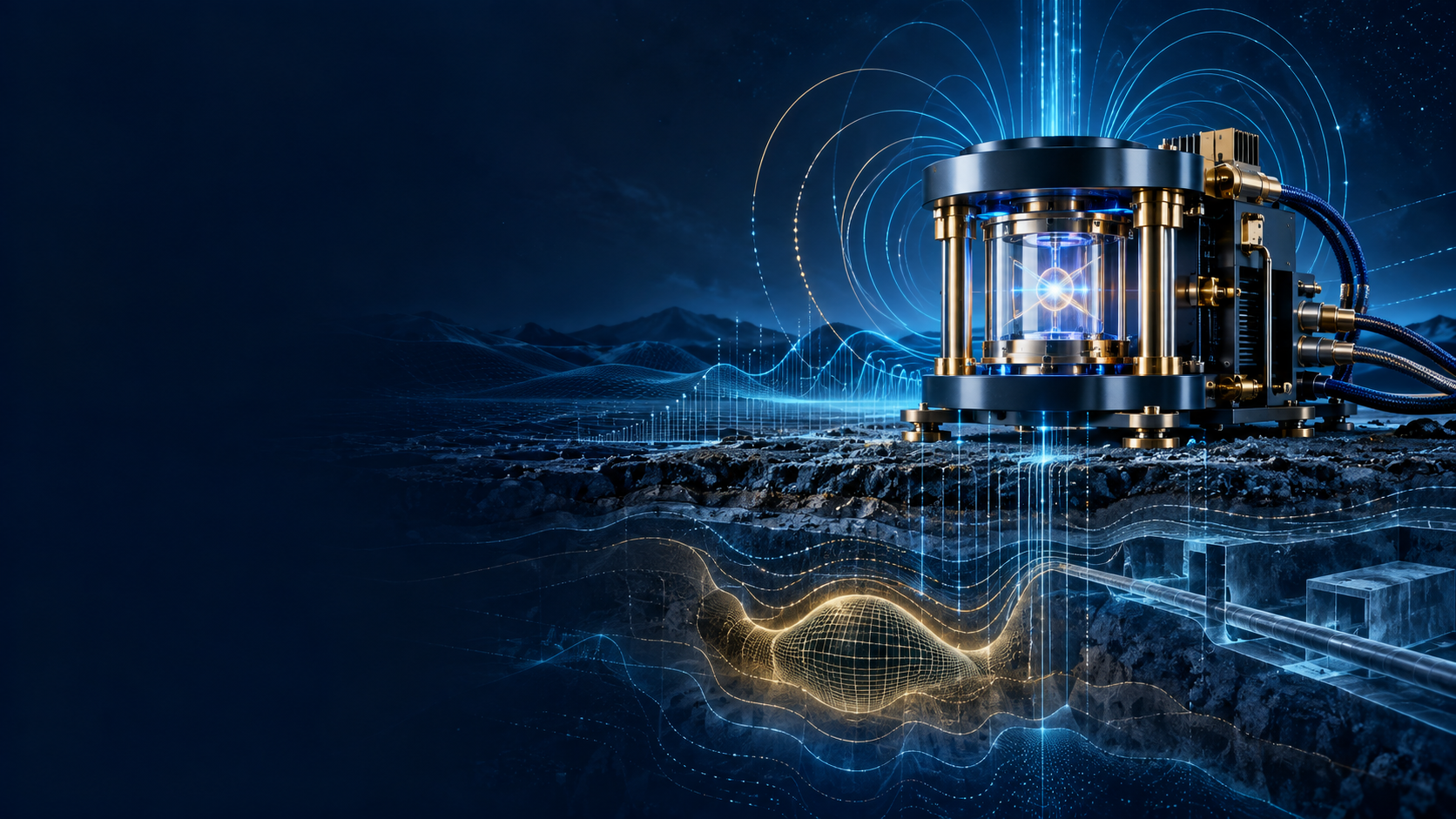
In a landmark field demonstration, researchers used a quantum gravity gradiometer to detect a two-metre tunnel beneath an urban site. The instrument compared the behaviour of two vertically separated clouds of rubidium atoms, allowing common vibration noise to be suppressed. The survey located the tunnel across an 8.5-metre line at half-metre spatial intervals. This did not create an effortless camera for the underground. Interpretation still required site information, modelling and uncertainty analysis. It did show that an atom-based instrument could leave the laboratory and resolve a civil-engineering target in a difficult environment. 5
The practical applications are substantial. Better knowledge of subsurface conditions could reduce uncertainty before excavation, help locate large utilities or hidden voids, identify conditions associated with sinkholes and improve the monitoring of aquifers. The value is not the sensor alone. It comes from combining a trusted measurement with geophysical models and an interface that converts a faint signal into an actionable estimate of location, depth and uncertainty.
Listening to the Magnetic Fields of the Body
The body produces magnetic fields as electrical signals move through nerves, muscles and organs. Magnetoencephalography measures the tiny fields generated by brain activity. Conventional systems usually use superconducting sensors that require cryogenic cooling and place the sensor array at a fixed distance from the scalp.
Optically pumped magnetometers offer a different approach. These atomic sensors can operate without cryogenic cooling and can be positioned closer to the head. Research systems have been built into wearable arrangements that allow a participant to move while brain activity is recorded. That flexibility is especially relevant for children and for studies involving natural movement. It may also support more adaptable scanner designs and new clinical research. 67
The word “may” is important. A compelling measurement platform is not automatically a clinical service. Medical adoption requires repeatable performance, safe workflows, appropriate trials, regulatory approval, training and evidence that the technology improves decisions or outcomes. The UK’s quantum missions include ambitions for quantum-enabled brain scanners and other sensing solutions across the NHS, but those ambitions are targets for translation, not proof that routine deployment has already been achieved. 3
Time as Critical Infrastructure
Some quantum sensors measure time rather than space, force or magnetism. Atomic clocks use transitions between energy states as highly stable frequency references. Their importance is easy to miss because time is usually experienced as a display, not infrastructure. In practice, precise timing helps synchronise mobile communications, data networks, energy systems, transport and financial transactions. 8
Compact atomic and optical clocks could give critical systems a stronger local reference when satellite timing is disrupted. They could also improve the coordination of distributed sensors and navigation systems. As with other quantum devices, commercialisation depends on far more than achieving an impressive result under controlled conditions. Instruments need test procedures, traceability to recognised standards and evidence of how temperature, humidity, vibration and magnetic fields affect performance. The National Physical Laboratory is developing facilities and methods to evaluate these systems against national and international references. 8
Why Deployment Is Harder Than Detection
The central challenge is no longer simply whether a quantum effect can be measured. It is whether a complete system can deliver useful information reliably, affordably and repeatedly in the environment where it is needed. That requires progress in lasers, vacuum systems, photonics, packaging, software, calibration and manufacturing. It also requires integration with existing processes. A construction team needs a survey result, not a demonstration of atomic coherence. A clinician needs evidence that a new scanner improves care. A navigator needs a system that can be maintained and trusted during prolonged operation.
Size, weight, power and cost remain important constraints. So do measurement speed, operating range and resistance to background noise. A sensor that is exceptionally sensitive may also respond to unwanted environmental changes. Quantum advantage therefore has to be defined for a specific task: greater accuracy, a new kind of signal, improved portability, lower operating burden or resilience when a conventional system fails. If the advantage cannot be connected to an operational requirement, sensitivity becomes a laboratory statistic rather than a capability.
Standards and procurement matter as well. Buyers need ways to compare instruments, verify claims and understand calibration. Regulators need evidence appropriate to the sector. Supply chains must be able to produce specialised components consistently. The UK has expanded work on quantum standards, while recent innovation funding has explicitly targeted the technical and commercial barriers that prevent sensing and position, navigation and timing technologies from being adopted. 91011
A Strategic Capability Rather Than a Distant Curiosity
Quantum sensing should not be presented as a single revolution arriving everywhere at once. Different platforms are at different levels of maturity, and many will remain specialised. The useful question is narrower: where does an organisation depend on a signal that is too weak, too easily disrupted or currently unavailable?
That question changes investment decisions. Infrastructure operators can identify the cost of uncertainty below ground. Transport and defence organisations can examine their dependence on satellite signals. Health systems can distinguish a promising scanner from a clinically validated service. Telecoms and energy providers can assess the consequences of losing precise timing. In each case, the case for a quantum sensor begins with the operational problem, not with the technology label.
The machines that sense the invisible are beginning to move beyond the lab, but their future will be shaped by engineering discipline as much as quantum physics. The organisations that benefit will not be those that treat “quantum” as a badge of novelty. They will be those that understand what must be measured, how much confidence is required and how a new instrument fits into the decisions people already make.
References
2. Department for Science, Innovation and Technology (2023). National Quantum Strategy.
3. Department for Science, Innovation and Technology (2023). National Quantum Strategy Missions.
5. Stray, B. et al. (2022). Quantum sensing for gravity cartography. Nature, 602, 590-594.
8. National Physical Laboratory. Quantum clocks and sub-components.
9. National Physical Laboratory. Quantum standards.
11. UK Research and Innovation (2026). Accelerating adoption of quantum enabled sensing and PNT.