
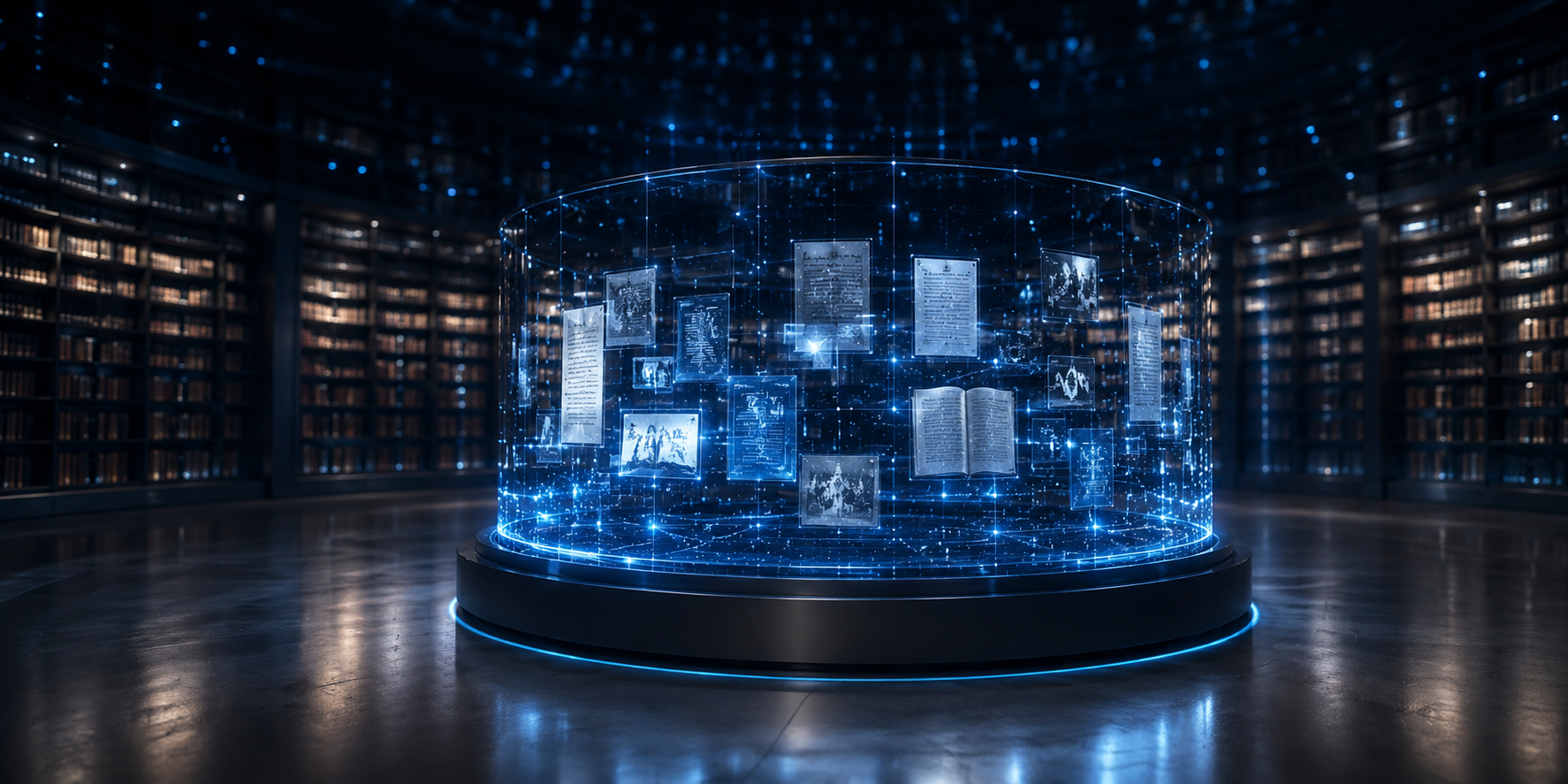
Introduction:
Every generation inherits more than knowledge; it inherits a record of the discoveries, decisions and experiences that came before it. Scientific breakthroughs build upon earlier research, legal systems depend upon historical records, and societies preserve cultural artefacts to understand their own identity. Progress has always relied not only upon creating new knowledge, but upon ensuring that it survives long enough to inform the future.¹
For centuries, preservation was primarily a physical undertaking. Libraries safeguarded manuscripts, museums protected artefacts, and archives maintained official records that documented the development of nations, institutions and scientific thought. Today, much of humanity’s memory exists in a fundamentally different form. Scientific datasets, medical records, satellite imagery, government documents, financial transactions and cultural works are increasingly created, stored and shared as digital information.²
This transition has transformed preservation from an archival discipline into a technological challenge. Digital information can be copied and distributed almost instantly, yet it remains surprisingly fragile. Hardware becomes obsolete, software evolves, storage media deteriorate and cyber threats continue to grow. A digital record may survive indefinitely in theory while becoming inaccessible in practice because the systems required to read or verify it no longer exist.³
As governments, research institutions and technology companies generate unprecedented volumes of information, preserving digital memory has become increasingly significant. The challenge is no longer simply how to store information, but how to ensure that the knowledge societies create today remains authentic, accessible and meaningful for generations using technologies that have yet to be developed.
Digital Preservation as Critical Infrastructure
Digital preservation is often misunderstood as simply backing up files. In reality, it is an ongoing process designed to ensure that information remains accessible, understandable and trustworthy despite continual technological change. A document that still exists but can no longer be opened, interpreted or verified has, for most practical purposes, been lost.⁴
This distinction has become increasingly important as digital technologies reshape almost every aspect of modern life. Governments conduct public administration electronically, hospitals manage patient records digitally, universities produce vast research repositories and scientific instruments generate datasets measured in petabytes rather than pages.⁵ The value of this information depends upon its availability not only today, but decades into the future.
Preservation also underpins trust in public institutions. Courts rely upon authentic digital evidence, regulators require accurate records and scientific research depends upon datasets that can be revisited, verified and reproduced. Without reliable preservation, the continuity upon which research, governance and accountability depend begins to erode.
Yet preserving digital information is becoming increasingly difficult because of the sheer scale of material now being created. Every day, satellites capture continuous streams of Earth observation data, laboratories generate new experimental results and organisations produce billions of digital records. Preserving everything is neither technically practical nor economically sustainable. Institutions must therefore decide what should be retained, how long it should remain accessible and who should be responsible for its long-term stewardship.
Preservation has consequently become a form of critical infrastructure. Like communications, energy or transport networks, digital repositories now support the continuity of scientific knowledge, institutional memory and cultural heritage upon which future progress depends.
The Fragility of Digital Memory
Despite their apparent permanence, digital records are often more fragile than their physical counterparts. A printed manuscript may survive centuries with visible signs of ageing, whereas a digital file can become inaccessible almost overnight through hardware failure, software obsolescence or incompatible file formats.⁶
Scientific research illustrates this challenge particularly clearly. Long-term studies in fields such as climate science, astronomy and epidemiology depend upon comparing contemporary observations with data collected decades earlier. Preserving these records involves more than retaining files alone; it requires maintaining metadata, documentation and technical compatibility so future researchers can accurately interpret the information.⁷
Digital preservation has also become inseparable from cybersecurity. Archives face growing risks from ransomware, accidental deletion and malicious attempts to alter records. Protecting digital memory therefore requires resilient infrastructure, secure authentication and governance frameworks capable of preserving not only information itself, but confidence in its authenticity.
The information age presents a paradox. Never before has humanity generated so much knowledge so rapidly, yet preserving that knowledge requires continuous technological intervention. Unlike physical archives that may survive with minimal attention, digital repositories demand ongoing maintenance, migration and adaptation if they are to remain accessible over time.
Artificial Intelligence and the Future of Archiving
As digital collections continue to expand, artificial intelligence is increasingly supporting rather than replacing archivists and information professionals. Machine learning systems can assist with cataloguing, image recognition, document transcription and metadata generation, enabling institutions to organise collections whose scale would be impossible to manage manually.⁸
Artificial intelligence is also improving long-term repository management. Predictive systems can identify storage failures before data are lost, detect integrity issues and recommend migration strategies as technologies evolve. For scientific research, AI-assisted archives may eventually enable researchers to identify relationships between publications, datasets and observations that conventional search methods fail to reveal.
However, preservation has never been a purely technical exercise. Decisions about what should be retained inevitably reflect human judgement. Archives shape future understanding because they determine which records remain available to subsequent generations.
This becomes particularly significant as cultural heritage increasingly exists in digital form. Websites, online publications and social media content now document contemporary society, yet no institution possesses the resources to preserve everything. If artificial intelligence begins influencing these decisions, questions emerge regarding transparency, bias and accountability. Algorithms may improve efficiency, but they cannot independently determine what future generations should remember. Human oversight therefore remains essential.
Authenticity, Trust and Governance
Preservation concerns more than ensuring that information survives. It also requires confidence that preserved information remains authentic. A record that has been manipulated, altered or removed from its original context may retain little historical, legal or scientific value regardless of whether the underlying file continues to exist.⁹
Maintaining authenticity has become increasingly complex as digital editing technologies evolve. Images, audio and video can now be modified with remarkable precision, while generative artificial intelligence has made highly convincing synthetic content increasingly accessible. In response, preservation strategies are expanding beyond storage alone to include provenance, cryptographic verification, digital signatures and immutable audit trails capable of documenting how information has been created, managed and preserved throughout its lifecycle.
At the same time, preservation has become a strategic governance issue. A significant proportion of the world’s digital information is stored within infrastructure operated by a relatively small number of global technology companies. While cloud computing has improved resilience and accessibility, it also raises important questions surrounding long-term stewardship, jurisdiction and digital sovereignty.¹⁰
Governments, research organisations and international institutions are therefore placing greater emphasis on resilient storage infrastructure, open standards and collaborative preservation strategies capable of adapting to continual technological change. Long-term preservation now depends not only upon technology itself, but upon governance frameworks that ensure digital knowledge remains secure, accessible and trustworthy over decades rather than years.
Concluding Observations
Every generation inherits knowledge because previous generations found ways to preserve it. While the materials have changed from parchment and paper to servers and cloud infrastructure, the underlying challenge remains remarkably consistent. Scientific progress, cultural identity and institutional trust all depend upon information surviving beyond the moment in which it was created.
The digital age has transformed both the scale of that challenge and the technologies available to address it. Artificial intelligence, resilient storage systems and advanced verification techniques offer new opportunities to safeguard humanity’s increasingly digital memory. At the same time, rapid technological change, cybersecurity threats and the growing complexity of digital information require preservation to be viewed as an ongoing process rather than a one-time act of storage.
The question is no longer whether digital preservation matters. It has become a fundamental component of modern infrastructure, supporting scientific research, democratic accountability and cultural continuity alike. As society continues to generate knowledge at unprecedented speed, one of its greatest responsibilities may not simply be discovering what comes next, but ensuring that what is known today remains available to inform the generations that follow.
Footnotes
- UNESCO, Memory of the World Programme: General Guidelines to Safeguard Documentary Heritage (2021).
- Organisation for Economic Co-operation and Development, Data Governance in the Digital Age (2023).
- Digital Preservation Coalition, Digital Preservation Handbook (2024).
- International Organization for Standardization, ISO 14721: Open Archival Information System (OAIS) Reference Model.
- European Commission, European Strategy for Data (2020).
- Library of Congress, Digital Preservation (2023).
- UK Research and Innovation, Good Research Resource Hub: Research Data Management (2023).
- The National Archives (UK), Machine Learning for Archives and Digital Collections (2023).
- National Institute of Standards and Technology, Digital Identity Guidelines and Data Integrity Frameworks (2023).
- UNESCO, Charter on the Preservation of Digital Heritage (2003, reaffirmed through subsequent digital preservation initiatives).