
Introduction:
The ocean remains one of the least operationally accessible environments on Earth despite underpinning critical components of modern global infrastructure. Submarine telecommunications cables transport the majority of international digital communications, offshore energy systems contribute significantly to global energy production, and marine ecosystems play a central role in climate regulation, resource security, and environmental stability.¹ ² Yet large sections of the deep ocean remain only partially mapped, intermittently monitored, and operationally difficult to access due to extreme pressure conditions, low visibility, corrosive environments, and substantial logistical constraints.
Recent advances in artificial intelligence, autonomous robotics, and marine sensing technologies are beginning to alter this landscape. Ocean infrastructure increasingly relies upon systems capable of operating with reduced human intervention, enabling persistent observation, environmental monitoring, predictive maintenance, and autonomous navigation across environments where direct human presence is often impractical.³ Artificial intelligence is no longer confined to terrestrial digital infrastructure; it is progressively becoming embedded within maritime systems, subsea operations, and oceanographic research architectures.
This transition is occurring alongside growing geopolitical and environmental pressures. Climate change is intensifying demands for marine observation capabilities, global data dependence increases the strategic importance of submarine infrastructure, and expanding offshore industries require more resilient monitoring systems capable of operating continuously in dynamic environments.⁴ In response, governments, research institutions, and private sector organisations are investing heavily in autonomous underwater vehicles, intelligent sensing networks, and AI-enabled marine analytics platforms designed to expand operational reach while reducing reliance on manual intervention.
While these developments create substantial opportunities for scientific discovery and infrastructure resilience, they also introduce broader questions surrounding autonomy, reliability, environmental impact, and governance. As decision-making capability becomes increasingly distributed between human operators and machine systems, determining how much operational authority should be delegated to autonomous technologies becomes an increasingly important consideration.
The question is no longer whether artificial intelligence will become integrated into ocean infrastructure, but how societies will manage increasingly autonomous systems operating within environments humans rarely see directly.
Current Applications of AI in Ocean Systems
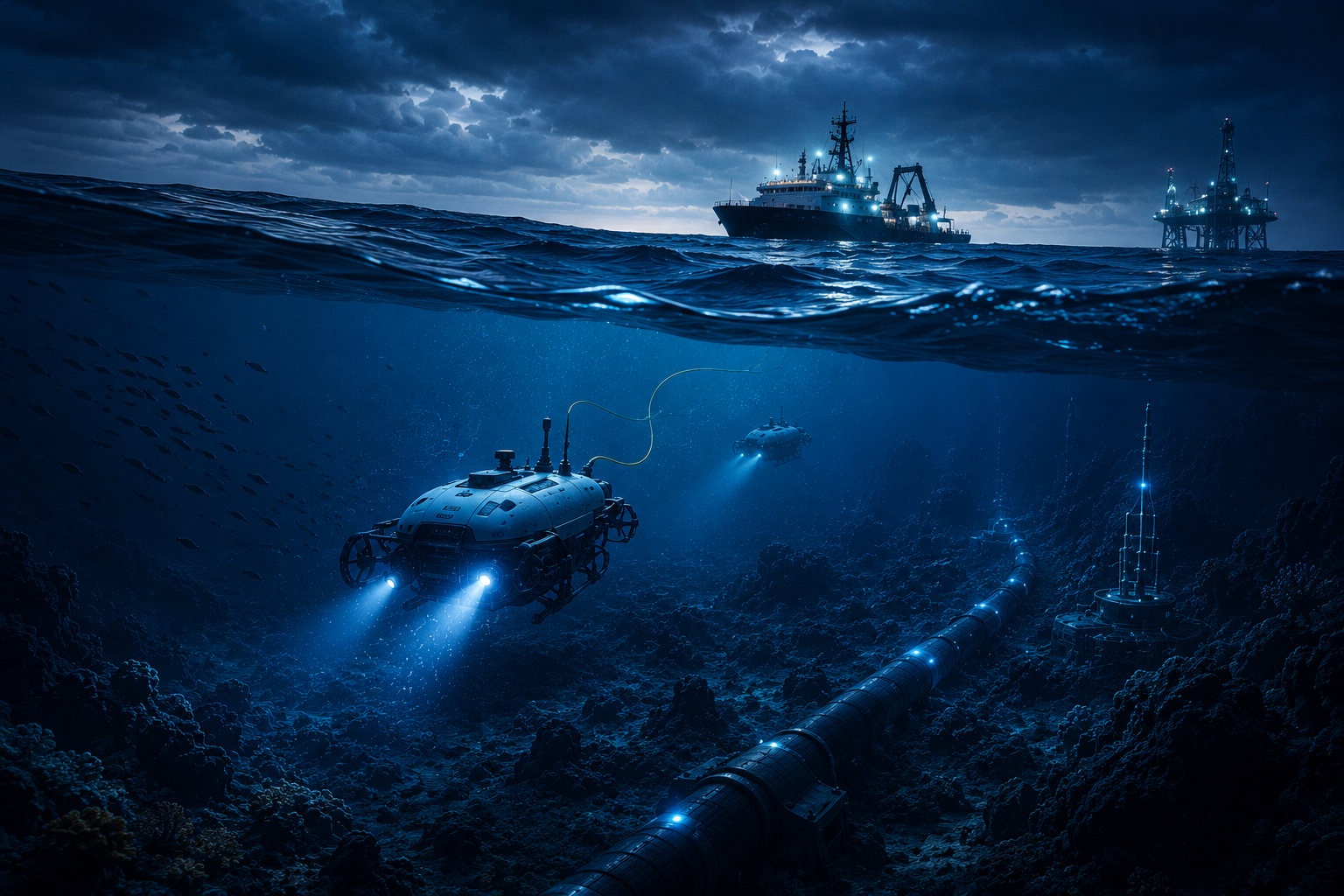
Artificial intelligence is increasingly embedded across marine operations, particularly within environments characterised by limited accessibility and high operational complexity. One of the most established applications involves autonomous underwater vehicles (AUVs), which are capable of conducting seabed mapping, infrastructure inspection, and environmental monitoring without continuous human control.⁵
Unlike traditional remotely operated vehicles that depend upon persistent operator input, modern autonomous systems increasingly integrate machine learning models capable of adapting navigation pathways, identifying anomalies, and optimising mission performance based upon changing environmental conditions.⁶ These capabilities are particularly valuable in deep-sea environments where communication latency and physical constraints limit direct operational oversight.
AI-enabled marine sensing systems are also transforming oceanographic research. Large-scale sensor networks continuously collect information relating to ocean temperature, salinity, currents, biodiversity activity, and chemical composition. Machine learning systems analyse these datasets to identify environmental trends, improve climate modelling accuracy, and support ecological forecasting.⁷
Beyond scientific research, artificial intelligence increasingly contributes to infrastructure resilience. Submarine telecommunications networks, offshore energy platforms, and maritime logistics systems rely upon predictive analytics platforms capable of identifying operational anomalies before failures occur. Predictive maintenance systems analyse vibration signatures, pressure fluctuations, and structural monitoring data to reduce downtime and improve infrastructure reliability.⁸
More advanced developments extend towards coordinated autonomous systems operating collectively rather than independently. Multi-agent marine robotics research increasingly explores how fleets of autonomous vehicles can collaborate to conduct distributed sensing operations, resource mapping, and environmental monitoring while dynamically reallocating tasks without centralised control.⁹
This shift represents a broader transformation in which ocean infrastructure is becoming increasingly computational, adaptive, and autonomous.
Operational Advantages and Associated Trade-offs
The primary operational advantage of integrating artificial intelligence into marine systems lies in persistence. Human exploration of extreme ocean environments remains constrained by safety limitations, cost, and physical endurance. Autonomous systems can operate continuously for extended periods, generating substantially larger observational datasets while reducing operational overhead.¹⁰
Artificial intelligence also improves responsiveness. Machine learning systems can process sensor information rapidly, identify emerging anomalies, and adjust operational behaviour without requiring delayed human intervention. Within infrastructure monitoring contexts, earlier anomaly detection may improve reliability while reducing maintenance costs. However, increasing autonomy introduces important trade-offs. Ocean environments remain inherently unpredictable. Variations in pressure conditions, visibility constraints, biological interference, and sensor degradation create operational uncertainty that can challenge machine learning systems trained predominantly under controlled conditions.¹¹
Unlike deterministic systems operating through predefined instructions, artificial intelligence models frequently generate outputs probabilistically. This introduces the possibility that autonomous systems encountering unfamiliar environmental conditions may behave unpredictably or produce inaccurate interpretations of sensor information. The issue therefore extends beyond technical capability alone. As autonomous systems assume greater responsibility within inaccessible environments, reliability, interpretability, and operational resilience become increasingly significant considerations.
Infrastructure Security and Environmental Risk
The growing integration of autonomous systems into marine infrastructure expands both operational capability and potential vulnerability. AI-enabled systems depend fundamentally upon data integrity, communication reliability, and secure computational architectures.
Adversarial manipulation, corrupted sensor inputs, and compromised data streams may influence how machine learning systems interpret environmental conditions.¹² Within critical infrastructure environments, incorrect system outputs could contribute to operational disruption, delayed maintenance responses, or broader infrastructure instability.
Marine environments introduce additional challenges not commonly encountered within terrestrial infrastructure systems. Saltwater corrosion, intermittent connectivity, hardware degradation, and limited maintenance accessibility complicate system resilience strategies. Updating autonomous systems operating remotely or at scale presents substantial engineering challenges, particularly where operational continuity must be maintained.
Environmental considerations also remain central. Expanding marine infrastructure must coexist alongside increasingly fragile ecological systems. Researchers continue evaluating how autonomous sensing networks, underwater robotics, and large-scale monitoring architectures interact with marine biodiversity and environmental sustainability objectives.¹³ Technological capability alone does not guarantee operational legitimacy. Long-term deployment strategies increasingly require balancing infrastructure resilience with ecological stewardship.
Human Oversight and Responsibility
Despite increasing operational autonomy, human oversight remains central to marine infrastructure governance. Current operational architectures frequently maintain human supervision within critical decision pathways, particularly where safety implications or infrastructure vulnerabilities are significant. However, maintaining meaningful oversight becomes increasingly complex as autonomous systems grow more sophisticated. Operators may supervise increasingly large autonomous fleets without direct visibility into every individual system decision. Machine learning outputs may also involve complex statistical processes that remain difficult to fully interpret.
Responsibility allocation therefore becomes increasingly important. If autonomous marine systems contribute to harmful outcomes, determining accountability may involve developers, operators, infrastructure owners, and deploying institutions simultaneously. Existing governance frameworks remain comparatively underdeveloped relative to the pace of technological advancement.¹⁴ As marine autonomy expands, regulatory structures will increasingly need to address explainability, accountability, and operational transparency.
Governance and Future Developments
International institutions increasingly recognise the importance of resilient ocean infrastructure and responsible marine technology development. Emerging governance discussions increasingly intersect environmental sustainability objectives, maritime security considerations, and broader questions surrounding autonomous system accountability.¹⁵ Bridging governance gaps will require more than regulation alone. Technical architectures themselves increasingly require explainability, auditability, and controllability as foundational design principles rather than retrospective additions.
As artificial intelligence continues extending operational capability into environments humans rarely access directly, maintaining trust in autonomous infrastructure becomes increasingly important.
The future of ocean systems will not simply depend upon what machines can observe beneath the surface. It will depend upon whether societies can govern increasingly intelligent infrastructure operating beyond immediate human visibility.
Concluding Observations
Artificial intelligence is reshaping ocean infrastructure by enabling persistent observation, predictive maintenance, autonomous navigation, and increasingly sophisticated marine monitoring capabilities. These developments expand scientific understanding while improving resilience across critical infrastructure systems that underpin global communications, energy security, and environmental management.
At the same time, increasing autonomy introduces important operational, environmental, and governance challenges. Questions surrounding transparency, accountability, resilience, and human oversight become increasingly significant as intelligent systems assume greater responsibility within inaccessible environments.
The central challenge is not whether autonomous technologies should operate within ocean systems, but how they can be integrated responsibly while preserving reliability, sustainability, and institutional trust. As digital infrastructure expands further into environments humans rarely reach directly, decisions made beneath the ocean surface may become increasingly consequential to life above it.
Footnotes
- International Telecommunication Union, Submarine Cable Resilience and Global Connectivity (2023).
- National Oceanic and Atmospheric Administration, Ocean Exploration Facts and Statistics (2024).
- United Nations Educational, Scientific and Cultural Organization, Ocean Decade Implementation Framework (2021).
- Organisation for Economic Co-operation and Development, The Ocean Economy in 2030 (2016).
- Woods Hole Oceanographic Institution, Autonomous Underwater Vehicles and Marine Exploration (2023).
- National Oceanography Centre, Advances in Marine Robotics and Artificial Intelligence (2024).
- National Aeronautics and Space Administration, Ocean Observation Systems and Climate Monitoring (2023).
- McKinsey & Company, Predictive Maintenance Technologies Across Industrial Infrastructure (2022).
- IEEE Ocean Engineering Society, Multi-Agent Autonomous Marine Systems Research (2023).
- Schmidt Ocean Institute, Emerging Technologies in Deep Ocean Exploration (2024).
- Nature Machine Intelligence, Machine Learning Challenges in Dynamic Environmental Systems (2022).
- Ian Goodfellow, Patrick McDaniel and Nicolas Papernot, Making Machine Learning Robust Against Adversarial Inputs (2018).
- United Nations Environment Programme, Marine Ecosystem Sustainability and Emerging Technologies (2023).
- Organisation for Economic Co-operation and Development, Artificial Intelligence Governance Frameworks (2024).
- International Maritime Organization, Digitalisation and Autonomous Technologies in Maritime Systems (2024).