
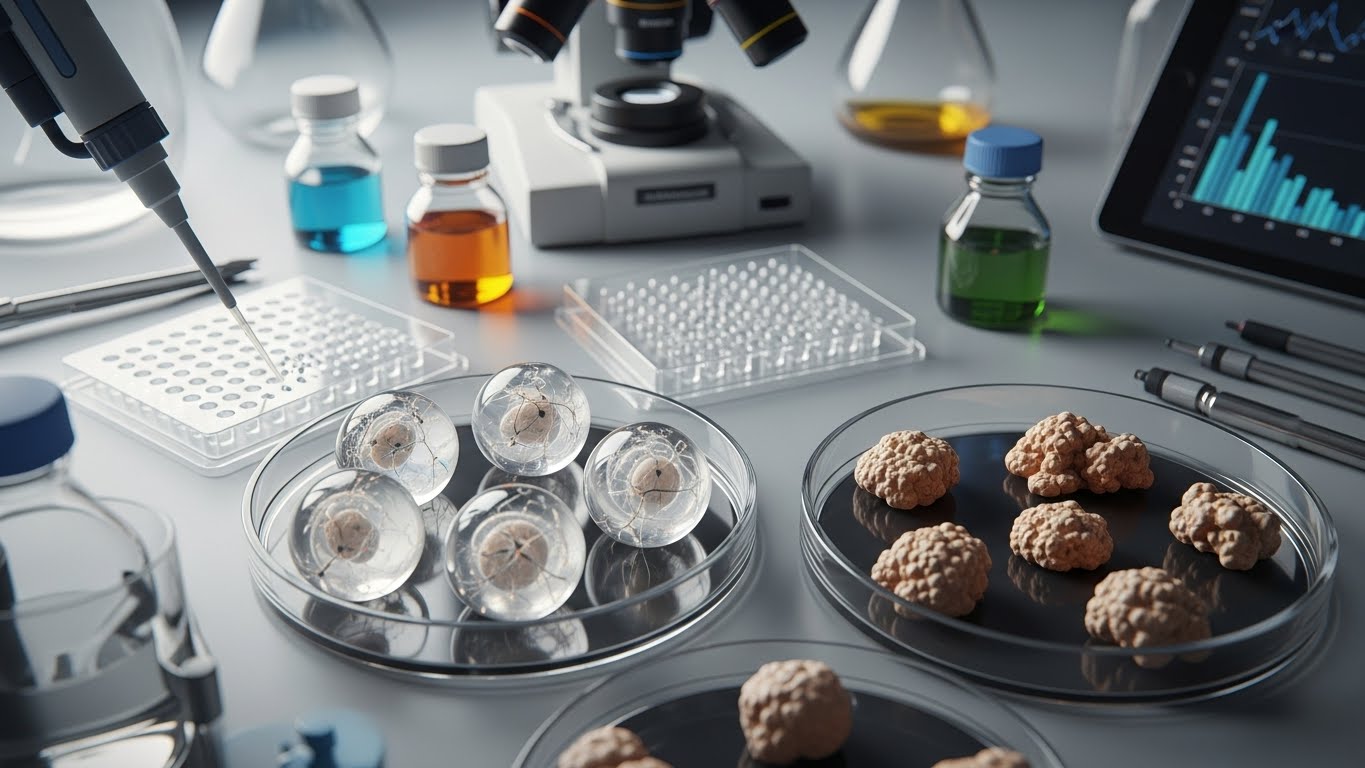
Imagine a tiny piece of human tissue in a dish behaving like a real organ. That’s essentially what organoids are: self-organising, three-dimensional “mini-organs” grown from human cells. Using stem cells (which can turn into many cell types) or adult tissue samples, researchers coax the cells in a gel or matrix to multiply and arrange themselves into a structure that mimics a real organ. These lab-grown models are small – often just a few millimetres across – but they contain many of the key cell types and architectural features of the actual organ. For example, brain organoids contain nerve cells (neurons) and support cells arranged in layers like a developing cortex, while tumour organoids include cancer cells together with elements of the tumour’s native microenvironment (stroma, blood vessels, etc.). By capturing real human biology in vitro, organoids let scientists study diseases and test drugs on human-like tissue rather than on artificial flat cultures or animal models.
How Are Organoids Made?
Growing organoids is much like baking a cake – a recipe with carefully controlled ingredients. Broadly, the steps are:
- Stem cells: First, scientists obtain the right starting cells. This might be induced pluripotent stem cells (iPSCs, made by reprogramming a patient’s skin or blood cells) or tissue-specific stem cells from a biopsy. In practice, organoids can be generated either from pluripotent stem cells or from adult stem-cell–containing tissue samples.
- 3D scaffold: The cells are then mixed into a 3D jelly-like scaffold (often Matrigel or similar) that mimics the body’s extracellular matrix. This provides structural support.
- Growth factors: The cells are bathed in nutrient-rich culture media that contains a cocktail of growth factors – chemical signals that guide development. These signals tell the cells how to specialise (for example, to become liver cells, gut cells, neurons, etc.).
- Self-organisation: Over days or weeks, the cells proliferate and self-organise into a tiny organ-like cluster. Remarkably, under the right conditions the cells sort themselves into layers and shapes similar to what is found in the real organ. The final mini-tissue can be maintained and even expanded for many passages.
With this method, researchers have grown organoids for many tissues – brains, kidneys, lungs, intestines, and even tumours. Each organoid type uses a slightly different recipe of factors, but the core idea is the same: a 3D environment + the right cells = a mini-organ in a dish.
Mini-Brains: Modelling the Developing Brain
Brain organoids (often called mini-brains) have become a powerful model for neuroscience. These specks of tissue contain neurons and glial cells (support cells) organised in layers that resemble a developing human brain. Even though they weigh only a few micrograms (with millions, not billions, of neurons), they recapitulate key brain features. Recent research has significantly advanced what mini-brains can do. For example, in 2024 scientists reported a method to make thousands of uniform brain organoids in one batch, solving a longtime scaling problem (they used a food additive, xanthan gum, to keep organoids from clumping). Another major breakthrough has been “multi-region” organoids: instead of growing just one brain area (like the cortex), researchers have started to fuse regions together. One study created an organoid containing connected cortex, midbrain and hindbrain tissues (even with primitive blood vessel cells), effectively a very rudimentary whole-brain in miniature.
These mini-brains show neural activity and development similar to a 6–8-week-old human foetus. They allow scientists to watch brain development and disorders unfold in real time. For instance, researchers have already used brain organoids to model neurodevelopmental conditions like autism or genetic syndromes. In a 2024 example, a team implanted patient-derived glioma (brain tumour) cells into brain organoids and ran a drug screen: the organoid platform revealed two known drugs (Selumetinib and Fulvestrant) that effectively stopped the cancer cells from invading the tissue. This shows how brain organoids can be used to test neurological drugs or even anti-cancer agents in a human-like setting. In fact, experts note that human brain organoids “hold promise for drug screening” and could greatly improve how we discover treatments for brain diseases. Because they model human brain tissue more closely than mice do, using brain organoids could “substitute for animal models”, speeding up testing and making it more predictive.
Mini-Tumours: Cultivating Cancer in a Dish
Organoids have also revolutionised cancer research. A tumour organoid is essentially a patient’s own cancer grown in miniature. Such organoids preserve the genetics and structure of the original tumour. In practical terms, this means a biopsy or surgical sample of, say, colon cancer can be expanded in the lab to form a 3D “mini-tumour” that carries all the mutations and quirks of the patient’s cancer. Scientists can then test different therapies on this mini-tumour to see what works best.
This personalised approach is already showing promise. In a recent project at the University of Waterloo, a team grew patient-derived tumour organoids in a special nanofibre gel and tested various chemotherapy drugs on them before treating the patients. They aim to match each patient with the drugs that shrink their tumour most effectively. In general, studies have found that organoid drug responses often mirror what happens clinically. For example, colorectal and pancreatic cancer organoids have been used to predict which chemotherapy a patient will respond to. Because organoids retain tumour heterogeneity and microenvironment, they reproduce how actual tumours react to treatment much better than flat cell lines. In one case series, drugs that killed the patient’s organoids also worked in the patient’s body, suggesting this could guide therapy choice.
Organoids in Drug Development and Personalised Medicine
The power of mini-organs extends beyond individual patients. In drug development pipelines, organoids offer a scalable, human-relevant testing platform. Pharma researchers can grow thousands of identical organoids to screen many compounds in parallel. Because human organoids mimic real tissue, they often catch toxicities or efficacy signals that animals miss. One review notes that brain organoids can help “shorten the drug-screening process and model human neurological diseases more accurately” compared to animal tests. In practical terms, this could mean faster discovery of safe, effective drugs.
Moreover, organoids are already used in precision medicine. Doctors are starting to use organoids as a lab “trial” of therapy. For example, in cystic fibrosis care, patient-specific organoids (grown from rectal or lung cells) are routinely used to test new CFTR-targeting drugs to see which drug most improves the patient’s ion channel function. This lets clinicians personalise treatment by picking the medication that works on the patient’s own cells. Likewise, tumour organoids can be co-cultured with the patient’s immune cells to test immunotherapy. If an organoid shrinks in response to a drug (while a “normal” organoid from the patient does not), it suggests that drug may really help the patient. Already, lab studies show that organoids from cancer patients have been used to screen drug responses in vitro and predict outcomes. In future, it’s envisioned that every patient could have a bank of organoids representing their tissues (brain, liver, tumour, etc.), allowing doctors to test multiple drugs simultaneously and choose the best therapy without trial-and-error on the patient.
In summary, organoids – the mini-brains and mini-tumours in our labs – are transforming research and medicine. They provide a bridge between simple cell cultures and complex human organs. By faithfully modeling human biology, they help scientists understand diseases, discover new drugs, and tailor treatments to each patient. With ongoing advances (such as adding blood vessel and immune components to organoids), these tiny lab-grown tissues promise to make drug development faster and more precise, ultimately bringing more effective therapies from bench to bedside.
Sources
Brain Organoids: A Game-Changer for Drug Testing
https://www.mdpi.com/1999-4923/16/4/443
Organoid Research
https://www.stemcell.com/technical-resources/area-of-interest/organoid-research.html
Tumor organoids: A review of culture methods, applications in cancer research, precision medicine, and drug development – PubMed
https://pubmed.ncbi.nlm.nih.gov/41180504/
Reliability of high-quantity human brain organoids for modeling microcephaly, glioma invasion and drug screening | Nature Communications
https://www.nature.com/articles/s41467-024-55226-6?error=cookies_not_supported&code=1d955044-e2db-4d98-b260-2f898c23b2c7