1. Introduction: The Shift from Automation to Autonomy
The history of robotics has largely been defined by containment. Industrial robots have operated within strict boundaries, bolted to factory floors and separated from humans by safety cages. Their programming was deterministic: specific inputs yielded predictable outputs.
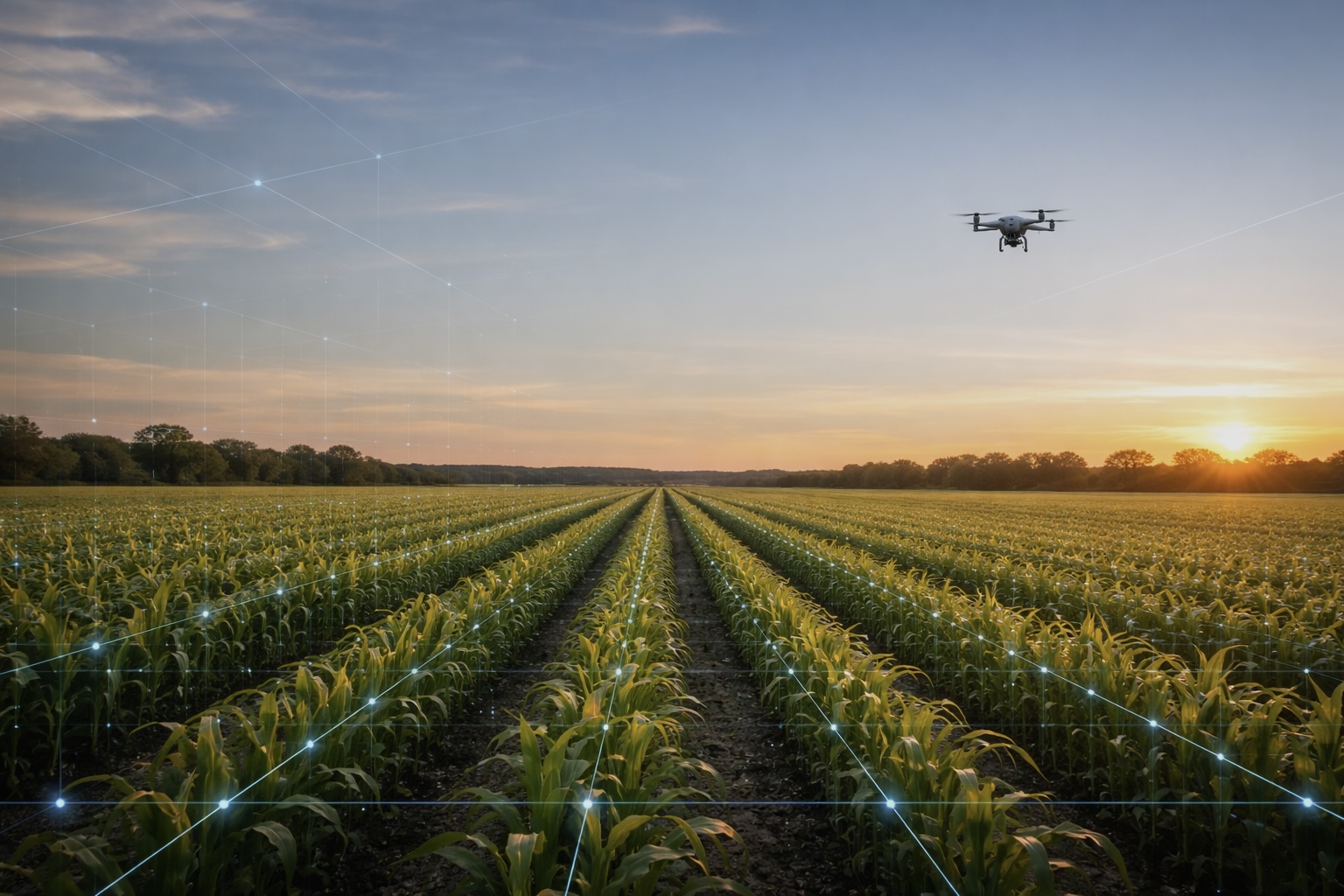
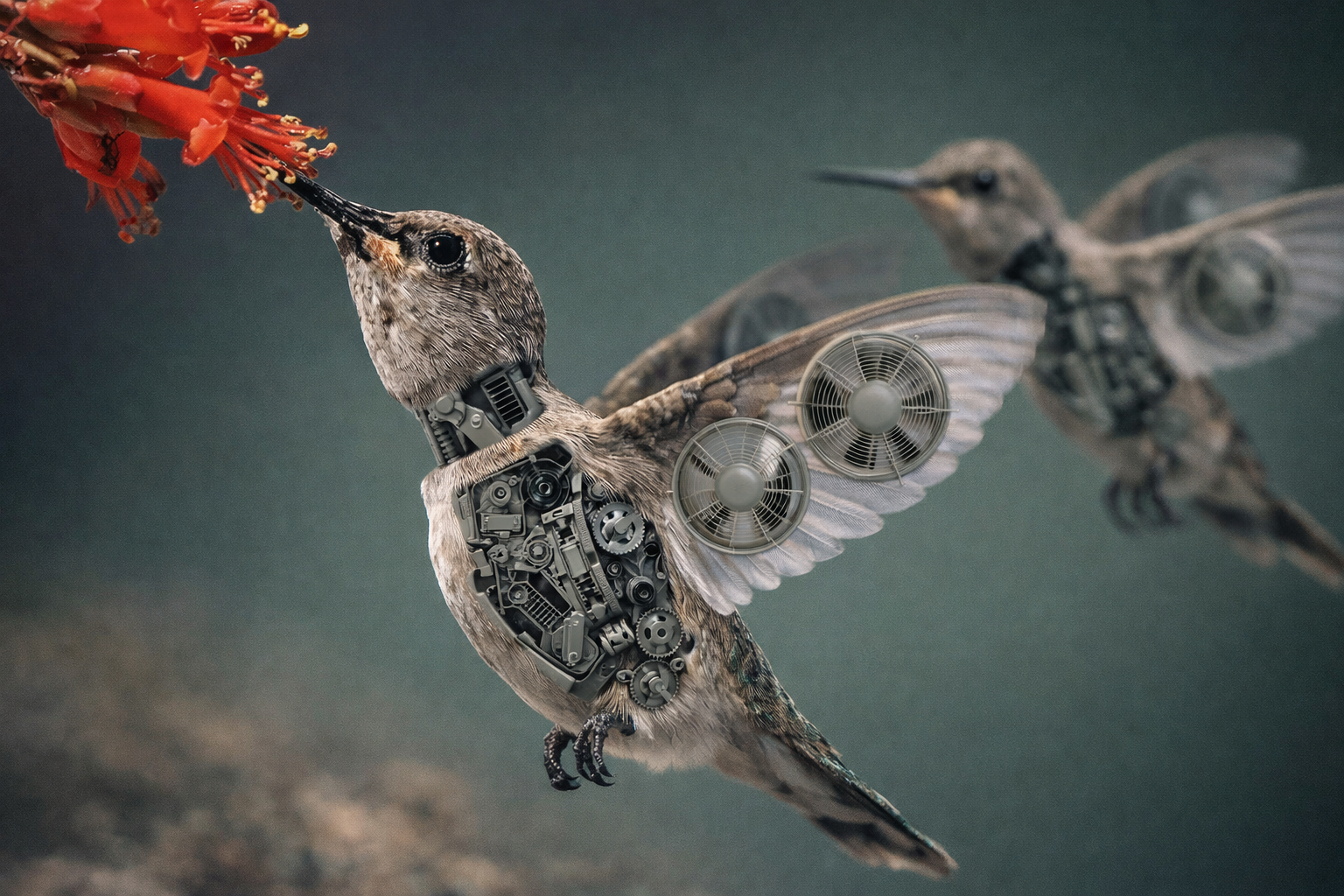
However, a technological paradigm shift is underway. We are moving from the era of automation to the era of autonomy. Driven by advances in bio-mimetic engineering and Artificial Intelligence (AI), a new class of robots is emerging. These machines are designed not to stand apart from the world, but to integrate with it. From robotic fish monitoring ocean health to drone swarms that mimic avian flocking patterns for disaster relief, these systems emulate the adaptability of biological life.
This transition is powered by Semi-Supervised and Unsupervised Learning, which are techniques that allow machines to learn from their environment rather than relying solely on pre-programmed instructions. Whilst this technical evolution offers immense potential for sectors ranging from healthcare to agriculture, it introduces a profound legal challenge: the erosion of predictability.
In our previous reports, The Algorithmic Leviathan and The Algorithmic State, we explored how AI challenges financial and state governance. Now, we must address the physical manifestation of this challenge. As robots gain the capacity to learn and adapt post-deployment, legal frameworks built on the concepts of “foreseeability” and “direct control” are being stretched to their limits.
2. Technical Context: Why “Unsupervised” Matters
To understand the regulatory challenge, one must first grasp the underlying technology. Traditional robots operate on Supervised Learning, akin to a student learning from an answer key. They function well in structured environments where every variable can be labelled and controlled.
Bio-mimetic robots, however, operate in unstructured environments i.e., deep oceans, shifting agricultural fields, or the human body. In these domains, the volume of data is too vast and chaotic to be manually labelled. Consequently, engineers are turning to alternative learning paradigms:
● Semi-Supervised Learning (SSL): This approach allows a system to infer patterns from a small amount of labelled data and a vast ocean of unlabelled data. It is critical for scaling operations where human expertise is scarce, such as training agricultural robots to identify new crop diseases.
● Unsupervised Learning (UL): Here, the system identifies anomalies or patterns without prior examples. In bio-mimetic swarms, this allows individual agents to coordinate locally without a central “brain”, much like a flock of birds adjusting to a sudden wind gust.
Whereas these methods grant robots the “common sense”needed to survive in the wild, they create a “Black Box” effect. If a system learns and evolves its behaviour after leaving the factory, tracing the decision-making process becomes mathematically complex, complicating the assignment of legal liability.
3. Legal Implications: The Foreseeability Doctrine
The central tension in governing bio-mimetic robotics lies in the legal doctrine of foreseeability. In tort law and product liability, a manufacturer is typically liable for harms that were reasonably foreseeable at the time of design.
3.1 The Liability Vacuum
If a bio-mimetic robot evolves a behaviour that causes harm, for instance, a delivery drone learning a risky flight path to conserve energy, a manufacturer might argue this was an unforeseeable adaptation, distinct from a manufacturing defect. This potential liability vacuum risks leaving victims without redress.
As such, Regulators in the Global North are moving to close this gap by shifting towards strict liability and lifecycle management:
● The European Union: The new Machinery Regulation (2023/1230) and the AI Act introduce rigorous conformity assessments for safety components that utilise machine learning. Crucially, they introduce the concept of “substantial modification”; if an AI system evolves beyond its original risk parameters, it may be treated as a new product requiring re-certification.
● The United Kingdom: The Automated Vehicles Act 2024provides a potential blueprint for robotics. It creates a statutory distinction between “user-in-charge” features and “self-driving” features. Once a system is authorised as self-driving, the human user is granted immunity from prosecution for driving offences, shifting liability squarely onto the Authorised Self-Driving Entity (ASDE).
3.2 The Duty of Continued Monitoring
This regulatory shift implies a new, ongoing duty of care. Manufacturers can no longer view a sale as the end of their responsibility. Instead, they must engage in Post-Market Monitoring, continuously auditing the “drift” of unsupervised models to ensure they remain within safe ethical and legal bounds.
4. Normative Frameworks: Control and Ethics
Beyond black-letter law, the deployment of autonomous systems raises normative questions regarding human agency and control.
4.1 Meaningful Human Control
The concept of Meaningful Human Control (MHC) has emerged as a standard for ethical autonomy. It posits that humans must remain morally responsible for the actions of intelligent systems. MHC consists of two conditions:
1. Tracking: The system’s behaviour must align with the moral reasons and intent of the human operator. Even a wild robot exploring a forest must track the operator’s intent to preserve the ecosystem.
2. Tracing: It must be possible to trace the outcome of the system’s actions back to a human agent (designer or operator).
For bio-mimetic swarms, where real-time control of every agent is impossible, governance must focus on control by design, that is,setting hard constraints that the unsupervised learning algorithms cannot override.
4.2 Bio-Hybrid Robotics and Legal Status
A more futuristic challenge is presented by bio-hybrid robotics, which integrate synthetic hardware with biological tissues (e.g., muscle actuators). These entities blur the legal distinction between “product” and “organism”. This raises questions about whether they should be regulated under machinery safety lawsor biosafety frameworks like the Cartagena Protocol. Ethical frameworks are currently struggling to categorise the moral status of machines that utilize living biological matter.
5. The African Perspective: Innovation and Sovereignty
As discussed in The Algorithmic State in Formation, Africa is cultivating a distinct regulatory environment driven by the dual imperatives of development and sovereignty.
● Development-First Approach: Whilst the EU prioritises the Precautionary Principle, the African Union’s Continental AI Strategy emphasises a Development-First paradigm. The continent faces an infrastructure gap that bio-mimetic robotics, such as autonomous drones for medical delivery or precision agriculture, could help bridge. Therefore, the tolerance for risk may differ, favouring innovation that solves immediate developmental challenges.
● Regulatory Sandboxes: Nations like Kenya and Nigeria are increasingly adopting regulatory sandboxes. These controlled environments allow for the testing of emerging technologies without the full burden of compliance, providing a pragmatic path for deploying bio-inspired solutions in agriculture and health.
● Biological Sovereignty: There is also a rising concern regarding the extraction of biological data. As bio-mimetic robots rely on data from the natural world, African policymakers are keen to ensure that local biological resources are not harvested to train foreign models without equitable benefit sharing, mirroring the broader push for Data Sovereignty.
6. Conclusion: Architecting Responsibility
The integration of semi-supervised and unsupervised learning into robotics promises a generation of machines with biological levels of adaptability. However, this technical leap must be matched by legal innovation.
We cannot govern these “algorithmic organisms” with static laws designed for inert machinery. The path forward requires a dynamic regulatory model: one that mandates continuous monitoring, enforces strict liability for emergent harms, and utilises regulatory sandboxes to foster innovation safely. By embedding legal principles into the very architecture of these systems, we can ensure that as robots learn to navigate our world, they do so as responsible agents of human intent.
Bibliography
Primary Sources
1. Automated Vehicles Act 2024, c 10.
2. African Union, Continental Artificial Intelligence Strategy(AU 2024).
3. Cartagena Protocol on Biosafety to the Convention on Biological Diversity (adopted 29 January 2000, entered into force 11 September 2003) 2226 UNTS 208.
4. Directive (EU) 2024/2853 of the European Parliament and of the Council of 23 October 2024 on liability for defective products OJ L 2024/2853.
5. Ministry of Information, Communications and the Digital Economy (Kenya), Cabinet Brief on the Review of the Proposed Kenya Robotics and Artificial Intelligence Society Bill and the Strategic Roadmap for Comprehensive AI Regulations (MICDE, January 2026).
6. Regulation (EU) 2023/1230 of the European Parliament and of the Council of 14 June 2023 on machinery OJ L 165/1.
Secondary Sources
7. Academy Team, ‘Semi-Supervised Learning: The Bridge Between Supervised and Unsupervised Learning’ (Medium, 2023) https://medium.com accessed 10 February 2026.
8. Asaro P, ‘The Liability Problem for Autonomous Artificial Agents’ (2016) AAAI Spring Symposium Series 191.
9. Fazli M and others, ‘Dynamic Safety Assurance for Learning-Enabled Autonomous Systems’ (2021) 12 IEEE Design & Test 45.
10. Hamann H, Swarm Robotics: A Formal Approach (Springer 2018).
11. Mestre R and others, ‘Ethics and responsibility in biohybrid robotics research’ (2024) 121 PNAS e2310458121.
12. Santoni de Sio F and van den Hoven J, ‘Meaningful Human Control over Autonomous Systems: A Philosophical Account’ (2018) 5 Frontiers in Robotics and AI 15.
13. ‘The Algorithmic Leviathan: Legal, Normative and Policy Dimensions of AI in Fraud Risk Engines and Threat Intelligence’ (Internal Report, 2026).
14. ‘The Algorithmic State in Formation: A Review of AI Policies, Strategies, and Legal Positions Across the African Continent’ (Internal Report, 2026).
15. Wang H and others, ‘Deep Reinforcement Learning in Biomimetic Robotics: A Survey’ (2020) 14 Frontiers in Neurorobotics 60.