Introduction: From Land to Data
For most of history, farming has been shaped by physical realities land, weather, labour, and knowledge passed down over time. Decisions were made through experience, observation, and instinct.
That is starting to change.
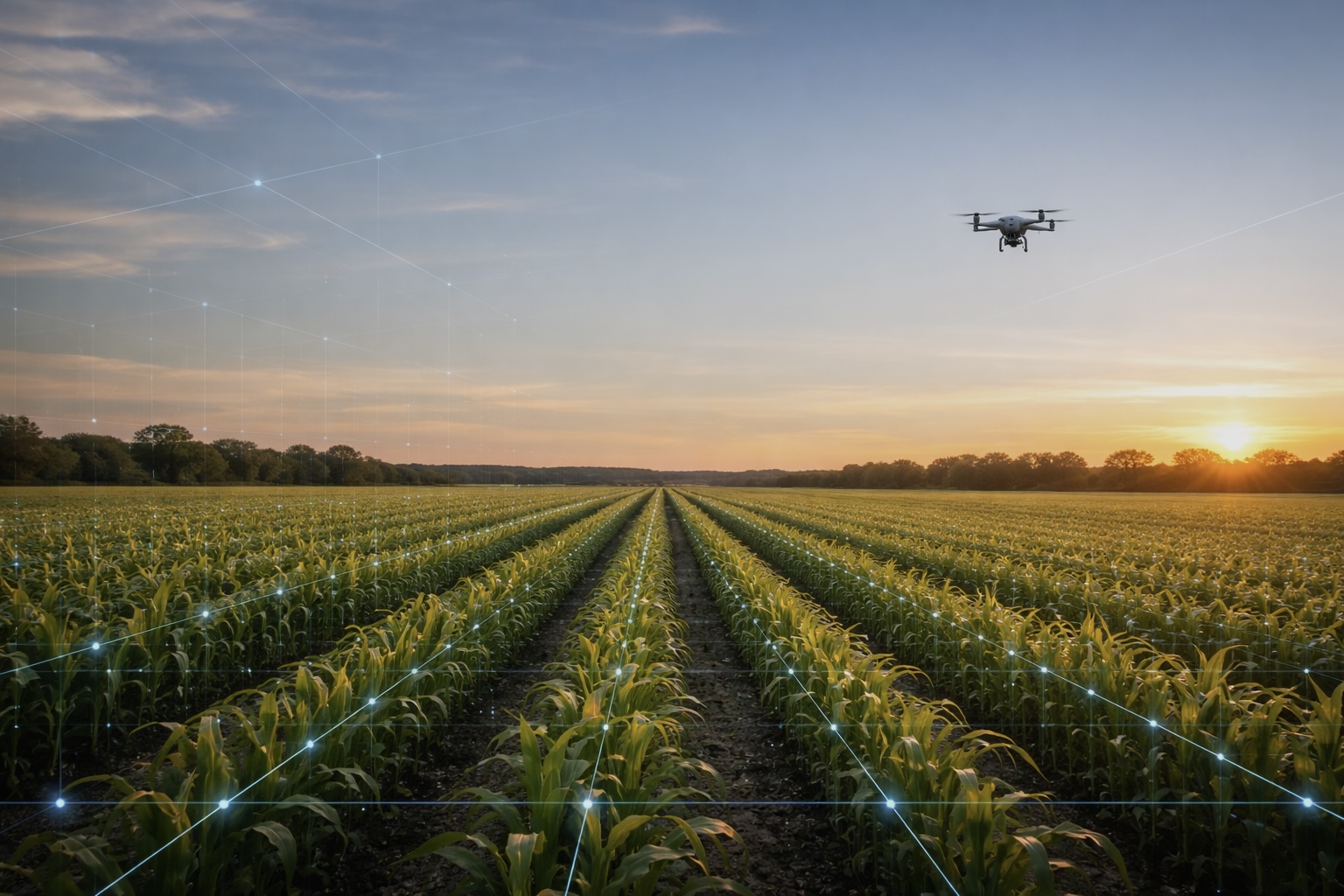
Across many parts of the world, agriculture is becoming increasingly digital. Fields are now monitored by drones, soil conditions are tracked through sensors, and machine learning systems are used to predict everything from crop yields to disease outbreaks. What was once a largely manual and experience-driven process is gradually becoming data-led.
This shift is not just about new tools. It changes how decisions are made. When farming becomes something that can be measured, modelled, and optimised, the role of the farmer begins to evolve too.
Like other areas we’ve explored from governance to robotics, agriculture is now becoming part of a wider algorithmic system. But here, the stakes feel particularly high. Food production sits at the centre of economic stability, environmental sustainability, and human survival.
So the question is not simply how AI can improve agriculture, but what happens when one of the most fundamental human systems becomes shaped by algorithms.
The Emergence of the Algorithmic Field
At its core, digital agriculture is about data.
Modern farming systems are increasingly built around three layers. First, data is collected through satellites, drones, and sensors embedded directly in the soil. Then that data is analysed, often using machine learning models that can detect patterns far beyond human observation. Finally, those insights are translated into decisions, sometimes suggested to farmers, and sometimes carried out automatically.
This creates a very different kind of environment. Instead of relying solely on human judgement, decisions are now influenced and in some cases guided by systems.
For many farmers, this can be a powerful support tool. But it also raises a quieter question: as these systems become more central, who is really making the decisions?
Efficiency, Optimisation, and Their Limits
The appeal of AI in agriculture is easy to understand. These systems promise better yields, reduced waste, and more efficient use of resources. In a world facing climate uncertainty and a growing population, that matters.
AI-driven tools can help farmers use water more precisely, detect disease earlier, and reduce unnecessary pesticide use. They can also improve forecasting, helping to stabilise supply chains.
But efficiency is not always neutral.
Most systems are designed to optimise for specific outcomes, often yield or cost. Those priorities do not always align with longer-term environmental or social goals. A model that maximises short-term productivity might, for example, encourage practices that gradually degrade soil health.
There is also the question of scale. Systems designed for large, industrial farms do not always translate easily to smaller or more local agricultural contexts.
This leads to a key issue: who decides what “optimal” actually means?
Data Ownership and Control
One of the less visible but most important issues in digital agriculture is data.
AI systems rely on vast amounts of information collected directly from farmland. But the ownership of that data is often unclear. In many cases, it is gathered through platforms run by private companies, meaning farmers contribute data without necessarily retaining full control over how it is used.
This creates an imbalance.
Farmers generate the data through their land and work. Technology providers analyse it, build models from it, and then sell those insights back as services.
From a policy perspective, this raises concerns around control and dependency. If agricultural knowledge becomes concentrated within a small number of platforms, the balance of power within food systems could begin to shift.
In some regions, this also connects to broader concerns about digital dependency, where local resources are effectively extracted and processed elsewhere.
A Global Divide
The spread of AI in agriculture is not happening evenly.
In high-income regions, access to infrastructure, funding, and expertise makes it easier to adopt and scale these technologies. In contrast, many lower-income regions face barriers such as limited connectivity, high costs, and lack of technical support.
This creates a potential divide between:
• agricultural systems that are highly optimised and data-driven
• and those that remain vulnerable to environmental and economic pressures
At the same time, there is also potential for these technologies to support more resilient systems. Mobile-based tools, lower-cost sensors, and locally adapted solutions could provide meaningful support in contexts where traditional infrastructure is limited.
So the outcome is not fixed. AI in agriculture could either widen gaps or help close them, depending on how it is developed and implemented.
Legal and Regulatory Questions
As agricultural systems become more automated, legal questions become harder to answer.
If an AI system provides a recommendation that leads to crop failure, who is responsible? Is it the farmer who followed the advice, the company that built the system, or the platform that delivered it?
There is also the issue of transparency. Many AI systems operate as “black boxes”, making it difficult to explain how specific decisions are reached. In a sector as critical as agriculture, that lack of clarity can be problematic.
Some regulatory approaches in other industries point toward ongoing oversight, where systems are monitored continuously rather than only assessed at the point of deployment. But applying this in agriculture is not straightforward. Farming environments are unpredictable, shaped by weather, geography, and biological systems.
This makes standardisation difficult, and regulation more complex.
Agriculture as Critical Infrastructure
Agriculture is not just another industry. It underpins food systems, economies, and social stability.
As it becomes more digitised, new risks emerge. These include potential cyber threats targeting supply chains, failures within automated systems, and increasing reliance on centralised platforms.
This shifts the conversation. AI in agriculture is not just about innovation or efficiency. It becomes a question of resilience.
How do we build systems that are both advanced and robust? How do we avoid creating vulnerabilities while trying to improve performance?
Conclusion: A System Still Taking Shape
The integration of AI into agriculture is still unfolding. It offers clear opportunities such as, greater efficiency, improved forecasting, and more precise use of resources. At the same time, it introduces new questions around control, responsibility, and long-term sustainability.
Rather than viewing this shift as purely positive or negative, it may be more useful to see it as something that is still taking shape.
What matters is how these systems are designed, who controls them, and how they are governed. As agriculture becomes increasingly influenced by algorithms, the challenge is not just technological, it is about ensuring that these systems support the people and environments they depend on.
Because ultimately, this is not just about the future of farming. It is about the future of how we produce and sustain one of the most essential systems in society.